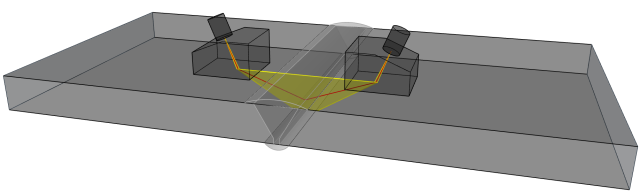
TOFD (Time of Flight Diffraction)
TOFD (Time of Flight Diffraction)
TOFD (Time of Flight Diffraction) is an advanced ultrasonic NDT technique using two probes to precisely locate and size internal weld defects like cracks, porosity, and lack of fusion in critical components (pipes, vessels). Its key applications include rapid weld inspection, in-service monitoring, HTHA assessment, and heavy wall thickness evaluation, offering high accuracy, speed, digital data storage, and the advantage of no radiation, making it ideal for oil & gas, power, and nuclear industries.
Key Applications & Uses
- Weld Inspection: Rapid, accurate inspection of critical welds in pipelines, pressure vessels, boilers, and storage tanks.
- In-Service Monitoring Comparing stored data to track known defects and assess their growth over time.
- Heavy Wall ThicknessThorough assessment of thick materials (e.g., reactors, heavy piping) for fabrication flaws.
- High Temperature Hydrogen Attack (HTHA): : Identifying damage in high-temperature service components.
- Manufacturing : IDetecting flaws during production for quality control.
Major Advantages
- High Accuracy: Precise sizing and location of defects.
- No Radiation: Safer than radiography, allowing in-service inspections during production.
- Speed & Efficiency: Faster than traditional methods, with quick setup and results
- Digital Data: Full data recorded digitally for documentation, review, and comparison
- Sensitivity: Detects various flaw types, regardless of orientation.
- Cost-Effective: Can reduce downtime and costs.
Industries Using TOFD
- Oil & Gas (Pipelines, Refineries)
- Petrochemical & Chemical Plants
- Power Generation
- Nuclear Industry (Developed for this sector)
- Marine & Offshores
- Fabrication