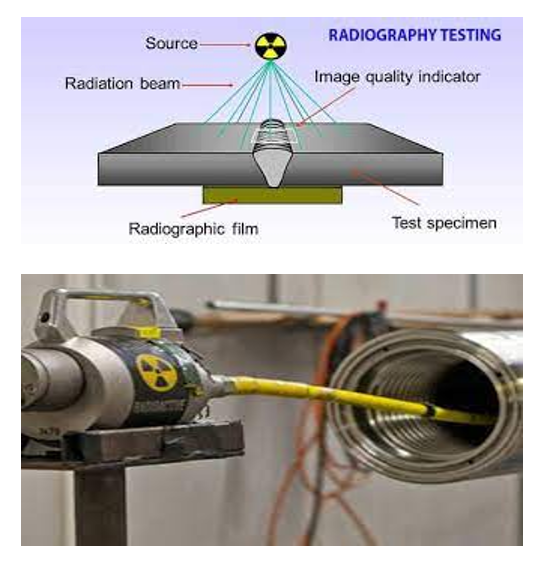
Radiography testing (RT)
Radiography testing (RT)
Radiography testing uses X-rays or gamma rays to create internal images of materials, revealing hidden flaws like cracks, voids, or corrosion, making it a vital Non-Destructive Testing (NDT) method in industries such as aerospace, oil & gas, and manufacturing for quality control and safety, checking welds, castings, pipelines, and pressure vessels without damaging them, with digital radiography offering instant results and enhanced image analysis.
Key Uses & Applications
- Weld Inspection:Verifying weld quality in pipelines, storage tanks, and structural steel.
- Material Integrity:Checking for internal defects (porosity, inclusions, cracks) in castings, machined parts, and components.
- Corrosion Monitoring:Detecting Corrosion Under Insulation (CUI) and flow-accelerated corrosion in operating pipes.
- Component Verification:Inspecting assembled parts for hidden foreign objects or missing components.
- Aerospace & Automotive:Ensuring safety and quality of critical parts like turbine blades or plastic components.
- Security & Forensics:Examining luggage, packages, and evidence.
Advantages
- Volumetric Inspection:Detects internal flaws, not just surface issues.
- Versatility:Works on various materials (metals, concrete, composites).
- Permanent Records:Creates durable film or digital records for analysis and historical tracking.
- Portability:Portable gamma-ray sources allow field inspections.
- Digital Benefits:Real-time images, enhancement, and easy storage.